AE 14: Modeling Housing Prices 🏠
In this application exercise we will be studying housing prices. The dataset is a cleaned version of publicly available real estate data. We will use tidyverse and tidymodels for data exploration and modeling, respectively.
We will use the ames_housing dataset from the modeldata package.
Before we use the dataset, we’ll make a few transformations to it.
- Your turn: Review the code below with your neighbors and write a summary of the data transformation pipeline.
data(ames)
housing <- ames |>
  select(Sale_Price, Gr_Liv_Area, Bldg_Type, Bedroom_AbvGr, Paved_Drive, Exter_Cond) |>
  mutate(home_type = fct_collapse(Bldg_Type,
    "House" = c("OneFam", "TwnhsE"),
    "Townhouse" = "Twnhs",
    "Duplex" = "Duplex"
  )) |>
  select(-Bldg_Type) |>
  rename(price = Sale_Price, sqft = Gr_Liv_Area, bedrooms = Bedroom_AbvGr) |>
  filter(home_type %in% c("House", "Townhouse", "Duplex"))
Here is a glimpse at the data:
glimpse(housing)Rows: 2,868
Columns: 6
$ price <int> 215000, 105000, 172000, 244000, 189900, 195500, 213500, 19…
$ sqft <int> 1656, 896, 1329, 2110, 1629, 1604, 1338, 1280, 1616, 1804,…
$ bedrooms <int> 3, 2, 3, 3, 3, 3, 2, 2, 2, 3, 3, 3, 3, 2, 1, 4, 4, 1, 2, 3…
$ Paved_Drive <fct> Partial_Pavement, Paved, Paved, Paved, Paved, Paved, Paved…
$ Exter_Cond <fct> Typical, Typical, Typical, Typical, Typical, Typical, Typi…
$ home_type <fct> House, House, House, House, House, House, House, House, Ho…Get to know the data
- Your turn: What is a typical house price in this dataset? What are some common square footage values? What types of homes are most common? Additionally, explore at least 1-2 other features that could be interesting. Share your findings!
# add code herePrice vs. square footage
How can we use square footage to model/predict pricing? Here is the model:
price_sqft_fit <- linear_reg() |>
  fit(price ~ sqft, data = housing)

tidy(price_sqft_fit)
# A tibble: 2 × 5
term estimate std.error statistic p.value
<chr> <dbl> <dbl> <dbl> <dbl>
1 (Intercept) 11430. 3271. 3.49 0.000482
2 sqft 114. 2.07 55.0 0 And here is the model visualized:
ggplot(housing, aes(x = sqft, y = price)) +
  geom_point(alpha = 0.4) +
  geom_smooth(method = "lm")
`geom_smooth()` using formula = 'y ~ x'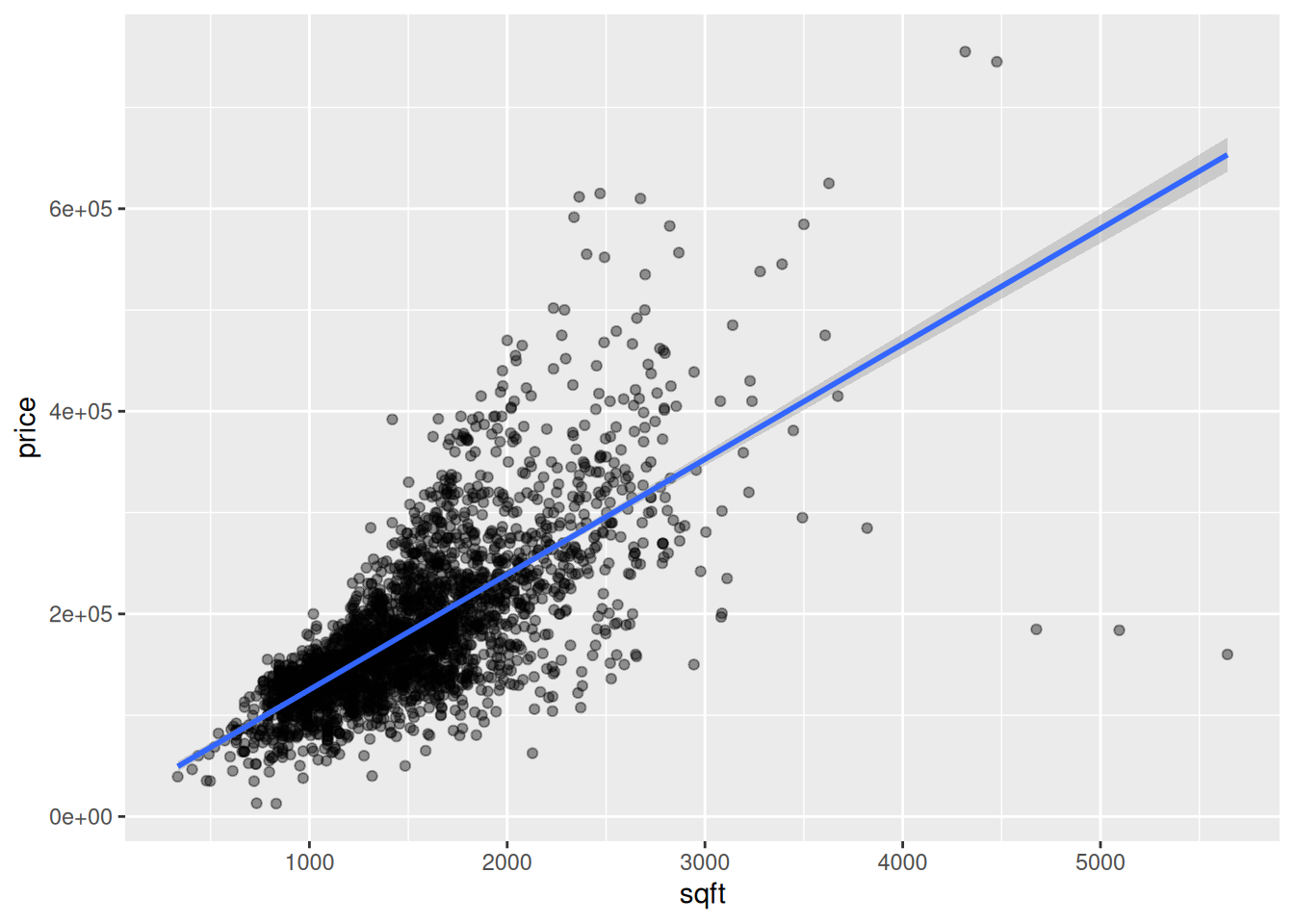
- Your turn: Write the fitted equation of the model in mathematical notation. Then, interpret the intercept and slope.
\[ add~equation~here \]
Price vs. home type
price_type_fit <- linear_reg() |>
  fit(price ~ home_type, data = housing)

tidy(price_type_fit)
# A tibble: 3 × 5
term estimate std.error statistic p.value
<chr> <dbl> <dbl> <dbl> <dbl>
1 (Intercept) 185469. 1537. 121. 0
2 home_typeDuplex -45661. 7746. -5.89 4.20e- 9
3 home_typeTownhouse -49535. 8036. -6.16 8.06e-10- Your turn: Write the fitted equation of the model in mathematical notation. Then, interpret the intercept and each coefficient in context.
\[ add~equation~here \]
Price vs. square footage and home type
Now, let’s fit a model that use both variables!
Main effects model
The main effects model is another name for the additive model. Here is the model:
price_main_fit <- linear_reg() |>
  fit(price ~ sqft + home_type, data = housing)

tidy(price_main_fit)
# A tibble: 4 × 5
term estimate std.error statistic p.value
<chr> <dbl> <dbl> <dbl> <dbl>
1 (Intercept) 13395. 3225. 4.15 3.38e- 5
2 sqft 115. 2.03 56.5 0
3 home_typeDuplex -63251. 5338. -11.8 1.19e-31
4 home_typeTownhouse -20306. 5552. -3.66 2.60e- 4- Your turn: Write the fitted equation of the model in mathematical notation. Then, interpret the intercept and each slope coefficient.
\[ add~equation~here \]
Interaction effects model
Now, we will fit an interaction effects model.
Task: Write code to fit an interaction effects model predicting price from square footage and home type.
#add code hereTask: Write the fitted equation using mathematical notation.
\[ add~equation~here \]
Task: Write the fitted equations for each home type.
\[ add~equation~here \] \[ add~equation~here \] \[ add~equation~here \]
Model Comparison
So, we fit multiple models - how do we know which one is better?
Using glance(), report each of the above models’ adjusted \(R^2\) values.
Which model is the best fit? Which is the worst?
# add code hereOne more model?
Task: Try adding one more variable present in the data frame to the “best” model chosen above. Does it make a difference in adjusted \(R^2\)? What about plain old \(R^2\)?
# add code here